

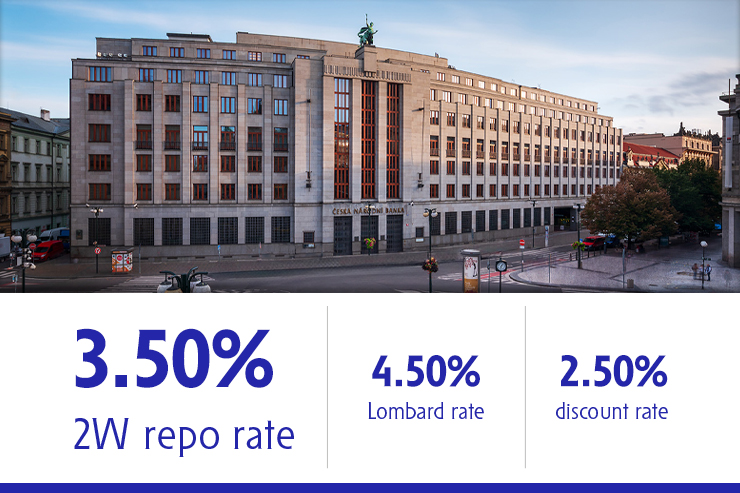
The Bank Board of the Czech National Bank Thursday (March 19, 2026) unanimously decided to keep interest rates unchanged. The two-week repo rate thus remains at 3.50%, where it has been since May last year.
Key figures from the meeting:
- 2W repo rate: 3.50% (unchanged since May 2025)
- Vote: 7:0 — full agreement of the entire Bank Board
- Inflation in February 2026: 1.4% year-on-year — the lowest level since October 2016, below the CNB’s forecast
- GDP in Q4 2025: +2.6% year-on-year — solid growth driven by household consumption
- Wage growth in Q4 2025: +7.4% year-on-year
- Inflation risks: balanced
- Rate outlook: approximate stability in the first half of 2026
Low inflation, but not a calm environment
February inflation at 1.4% looks encouraging at first glance — it is the lowest since October 2016. However, the headline figure hides two very different stories. Goods prices are declining, driven by cheaper energy following the transfer of renewable energy fees to the state and lower food prices. Services prices, however, are rising at a pace of 4.5% — precisely in the areas where households actually spend: rents, restaurants, accommodation, and leisure.
This is why the CNB is not responding to the favourable headline number with monetary easing. What matters for the central bank is core inflation, currently around 2.7%. Behind it are wages, which grew by 7.4% in the fourth quarter, while labour market tightness remains a significant domestic risk from the Bank Board’s perspective. The Board summarised today’s decision clearly:
“Today’s decision aims to keep headline inflation stabilised close to the 2% inflation target even after the temporary factors dissipate.”
A new factor on the radar: the Middle East
Compared to February, today’s meeting introduced one explicitly new element. The Bank Board formally included the conflict in the Middle East among the specific risks for the coming months. It will monitor not only the direct impact of higher energy prices on inflation, but also potential negative effects on economic activity and financial conditions. The key condition is clear: the consequences of the conflict must not translate into higher inflation expectations in the Czech Republic.
The same risk has been considered by the Fed, the ECB, and the Bank of England. All three have kept interest rates unchanged. In its decision, the Fed raised its inflation outlook partly in response to energy price developments, while the ECB warned of persistent uncertainty linked to geopolitical tensions.
At the same time, the Czech Bank Board states that the current impact of the conflict does not yet threaten the persistence of a low-inflation environment and that the favourable starting conditions of the domestic economy provide room to first analyse developments, observe the actions of major foreign central banks, and only then potentially respond.
Rate outlook: stability, not easing
The CNB’s winter forecast, on which today’s decision is based, assumes approximate stability of short-term market rates in the first half of the year. What follows remains open in both directions. Today’s assessment of risks as “balanced” is not a signal of an imminent rate move; rather, it indicates that the easing cycle, which began in December 2023 and ended in May 2025, is very likely complete.
The Bank Board stated:
“At its meetings ahead, the Bank Board will base its decisions on an assessment of newly available data and their implications for the inflation outlook. Its considerations about the interest rate settings will depend mainly on an evaluation of the persistence of the low-inflation environment, koruna exchange rate developments, the effect of fiscal policy on the economy, an analysis of the tightness in the labour market, and changes in domestic and external demand. The Bank Board will also monitor the actions of key foreign central banks, geopolitical events, the situation on foreign financial markets and developments in trade relations between countries. It will also assess the transmission of monetary policy to domestic lending activity, asset prices – above all property prices – and subsequently real economic activity and prices.”
What this means for real estate investors
According to the Czech Banking Association’s Hypomonitor, the average rate on new mortgages stood at 4.46% in February. A significant drop in borrowing costs is unlikely to come automatically — and if the repo rate were to move, mortgage rates would be more likely to increase than decrease.
This has a direct impact on investment logic: the cost of money is high enough to separate projects with real value from those that relied on cheaper debt to make the numbers work over time.
In an environment of stable but not cheap money, investments with a reasonable entry price, a clear and understandable location, stable rental demand, and yields that hold up without aggressive leverage perform best. Timing the market matters less; the quality of the specific asset and the way it is acquired matter more.
This is an environment where disciplined investment selection delivers results — and where the importance of predictable, contractually secured returns becomes evident, even without optimistic assumptions about future rate developments.